- Home
- Ireland Sightseeing
- Beyond the Castles
- Limerick Things to Know
Limerick Things to Know: Historic Town, Amusing Poem - Read on For a Little About Both!
Our virtual tour of Irish landmarks continues with Limerick things to know. If you are like many people, the only thing you know about the history of Limerick is that those funny, five-stanza poems were named after it (supposedly!)
How Well Do You Know Your Irish Stuff?
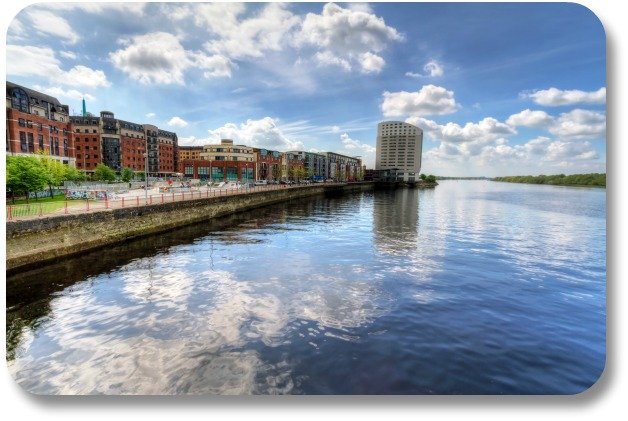
Many are unaware that the town of Limerick itself is a fascinating place, with a very interesting history and major attractions of its own. But whatever your interest in this famous Irish landmark, we have something for you here. Read on!
Limerick Things to Know: The City
Located in mid-western Ireland, this lovely city is tucked into the curves of the River Shannon not far from the estuary’s banks.
Despite common perception, we're not talking about a picturesque little country village - it’s actually the fourth largest city in the country!
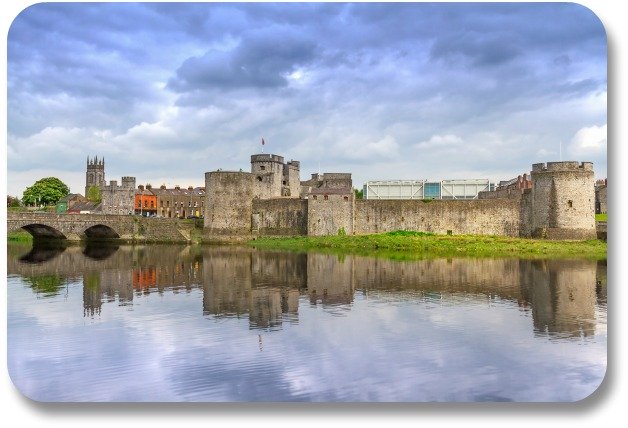
The "modern” history of Limerick goes back to the Viking days of 1,200 years ago. The Vikings (being Vikings and all) plundered, pillaged and burned the earlier, ancient settlement to the ground before founding their own town on the ashes of destruction.
Ancient Greek traders may also have landed at the estuary of the River Shannon, near the “original” Limerick. The evidence includes Ptolemy’s ancient maps, which show the estuary clearly.
In fact, an island within the city borders was once called by a name meaning “the Isle of the Dark-Haired Foreigners,” which is thought to be a reference to the ancient Greeks.
Legend has it that a number of Christian saints passed through the city during their travels throughout the Emerald Isle.
Trading prospered in the city
throughout the centuries, thanks to its favorable location on the
Shannon near the island’s west coast.

During the Irish civil wars of the 1600s, Limerick was besieged several times. As a result of all the strife, the city earned the motto “an ancient city well-studied in the arts of war.”
I guess the city had a lot to deal with back then.
So, visiting this famous city would allow you to walk in the footsteps of ancient Greek mariners, Viking plunderers and the builders of Norman castles and Gothic cathedrals, not to mention rebellious locals and Irish merchants.
Once you toss a few saints in for good measure, you realize the city itself is quite an interesting place.
A Few More Modern Limerick Things to Know
Limerick is the first Irish city to have “Street Ambassadors” – people who guide travelers through the city, making sure their stay is interesting and enjoyable. The city also boasts a vibrant nightlife, with plenty of warm, cozy pubs as well as high-energy nightclubs.
City sights include relaxing boat tours up and down the Shannon, the 13th-century King John’s Castle in the medieval district, Hunt’s Museum and its treasure trove of local Iron Age, Bronze Age and medieval objects, colorful festivals every year, and various fascinating walking tours.
Limerick is the setting for much of the best-selling book Angela’s Ashes, and one walking tour focuses on locations from the book and the film adaptation.
Limerick Things to Know: The Funny Little Poem
According to legend, the amusing poetic style called "limerick" is named after the city by the same name. Over the years, its popularity has made the name of the city almost a household word.
Limericks (the poems) are short and almost always humorous. Many are at least a little naughty as well. You can find many examples here.
English writer Edward Lear popularized this poetic style by including numerous examples in his 1846 Book of Nonsense. They often start out with the line “There was a …” and go from there. Here’s a relatively innocent example (some are quite raunchy):
“There was a young woman from Stroud,
Whose artistic skills did her proud,
She thought it not rude,
To paint in the nude,
And soon drew a sizeable crowd.”
A properly structured limerick contains five lines of rhyming verse. The final words of the first, second and last line rhyme with each other. The third and fourth lines offer a different rhyme.
The mists of time have obscured the connection between a limerick (the poem) and Limerick the city, but the poems probably first appeared in Ireland somewhere in or around County Limerick.
No matter where they came from, it's clear these little verses have helped to keep the city famous while brightening the days of countless people over the years.
Want More Irish Customs?
It is probably obvious - at Irish Expressions, we love Irish culture and customs. Expressing ourselves through these traditions gives us a deeper sense of connection with Ireland, wherever in the world we happen to be!
Over the years, we have created many downloadable, share-able Irish games, puzzles, recipes, songbooks, quizzes, and much, much more.
Want them right now? Keep reading to learn about "Your Irish Expressions Playbook."
Everybody Has an Irish Side...
More Fun With Irish Expressions:
Your Irish Expressions Playbook
Congratulations on learning more about what we like to call your "Irish Side." You may be thinking "I'd love to actually VISIT Ireland but that's really not in the cards right now. What am I supposed to actually DO with the stuff I just learned?"
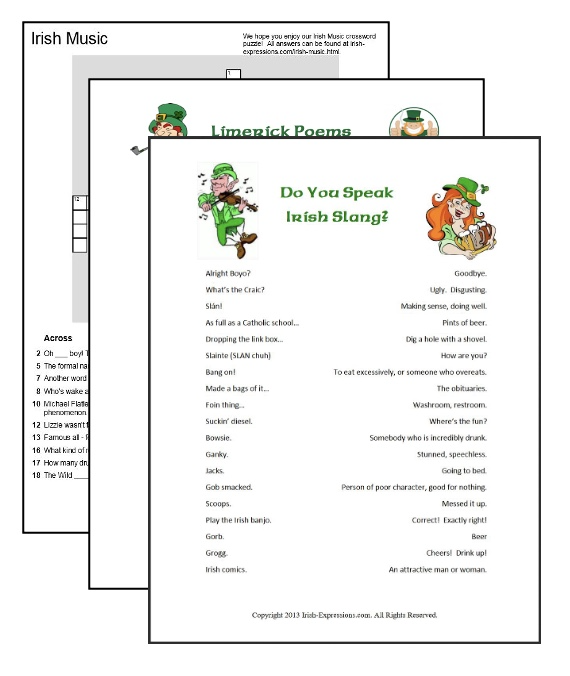
Well never fear! Since 2007 we have collected all of the best printable, shareable resources we could find, to help you put your new knowledge of Ireland to good use. We've put them all together on one page we call "Your Irish Expressions Playbook"
 |
GAMES | PUZZLES | RECIPES | MORE ... more downloads added daily! |
Think games ... puzzles ... recipes ... song lyrics ... Access them ALL for one small price. Print as often as you like and share them with your friends - with no limitations! Once you're in, you are in - forever.
But order soon - we are always adding to the IE Playbook and this price will not last long.
PRO TIP: Once you have checked out, you should be routed to your Playbook within 7 seconds. Or click the 'return to merchant' button to get there faster. Then bookmark the page, so you can return whenever you like.
Any issues? Just reach out to us at support@irish-expressions.com and we will make it right.
Please Share Your Feedback
Did we miss anything? Is there a topic you would like us to cover in the future? Tap HERE to let us know!
ENJOYING IRISH EXPRESSIONS? PLEASE SHARE US WITH OTHERS!
Recent Articles


-
How to Write a Limerick: An Easy, Fun Way to Show Your Irish Side!
Mar 12, 26 09:22 AM
 Learning how to write a limerick is one of the easiest and most entertaining ways to express your Irish Side. Read on for simple, easy to learn instructions!
 -
This Week in Ireland - St Patrick's Festival
Mar 08, 26 06:01 PM
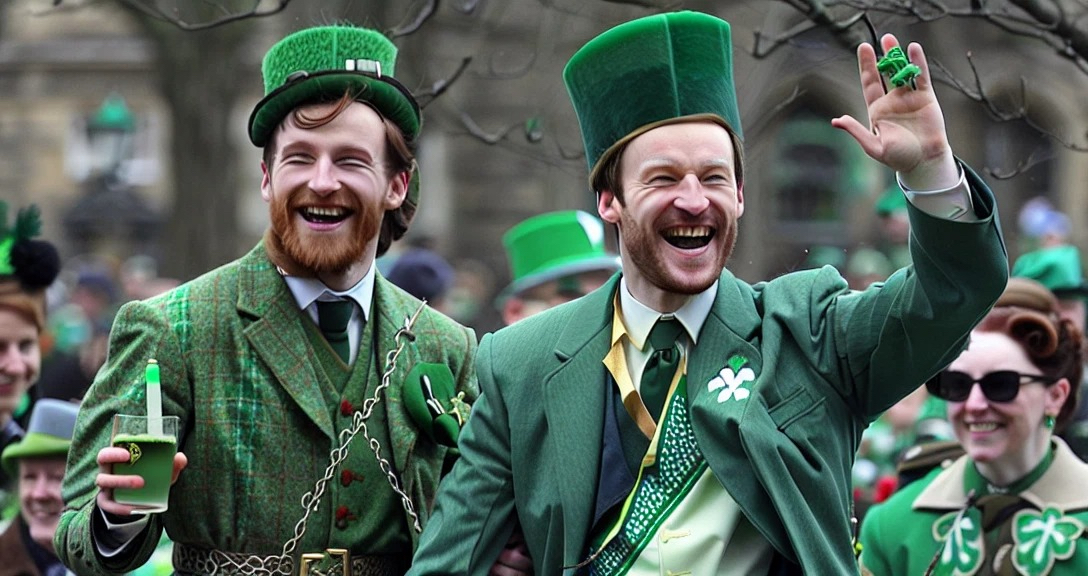
Dublin is leaning fully into St. Patrick’s Festival this week, with the official 2026 programme running from March 14 through March 17 and filling the city centre with performances, family events, wor…
-
Irish Expressions and Activities: Share Your Irish Side!
Mar 03, 26 07:17 PM
 Use Irish expressions and activities such as sayings, songs, symbols, sights, flavors, and fun to share your personal Irish side, wherever you are in the world!
 -
This Week in Ireland - Irish Language Festival
Mar 01, 26 04:07 PM
Across Ireland this week, a quiet cultural rhythm is rising: the annual celebration of Seachtain na Gaeilge has begun. Starting on March 1st and continuing toward St. Patrick’s Day, this is the larges…
-
This Week in Ireland - Birthday of George Bernard Shaw
Feb 16, 26 01:13 PM
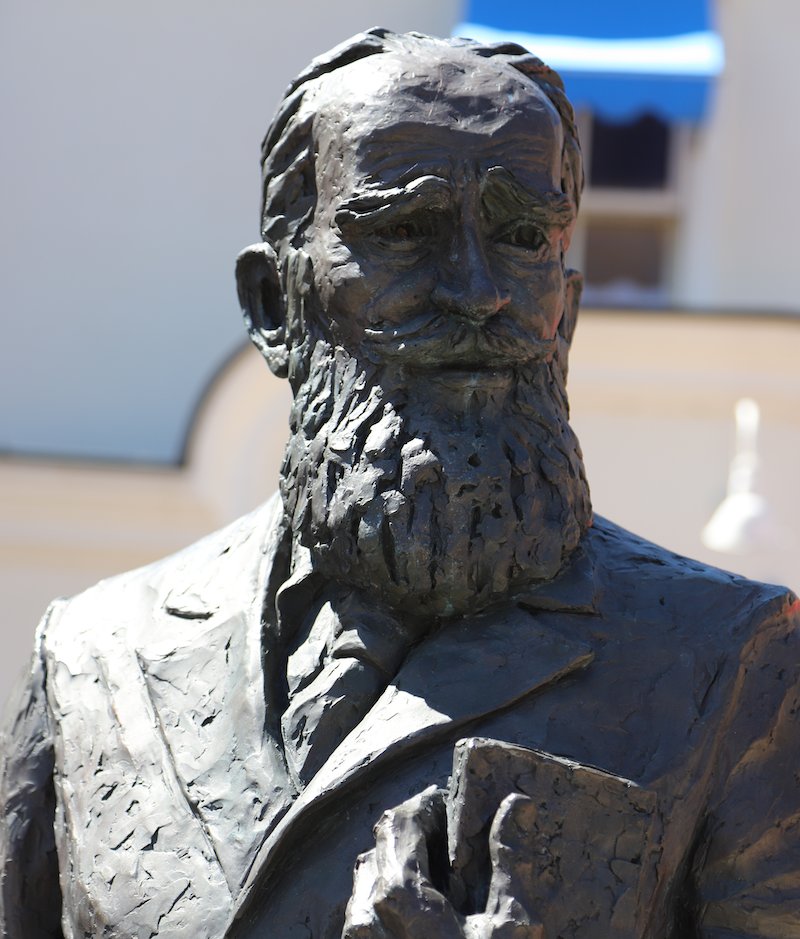
This week in Ireland marks the February 18 birthday of George Bernard Shaw, born in Dublin in 1856. Shaw remains one of Ireland’s most influential literary figures — a Nobel Prize-winning playwright w…
-
This Week in Ireland - Remembering Sean Treacy
Feb 08, 26 12:25 PM
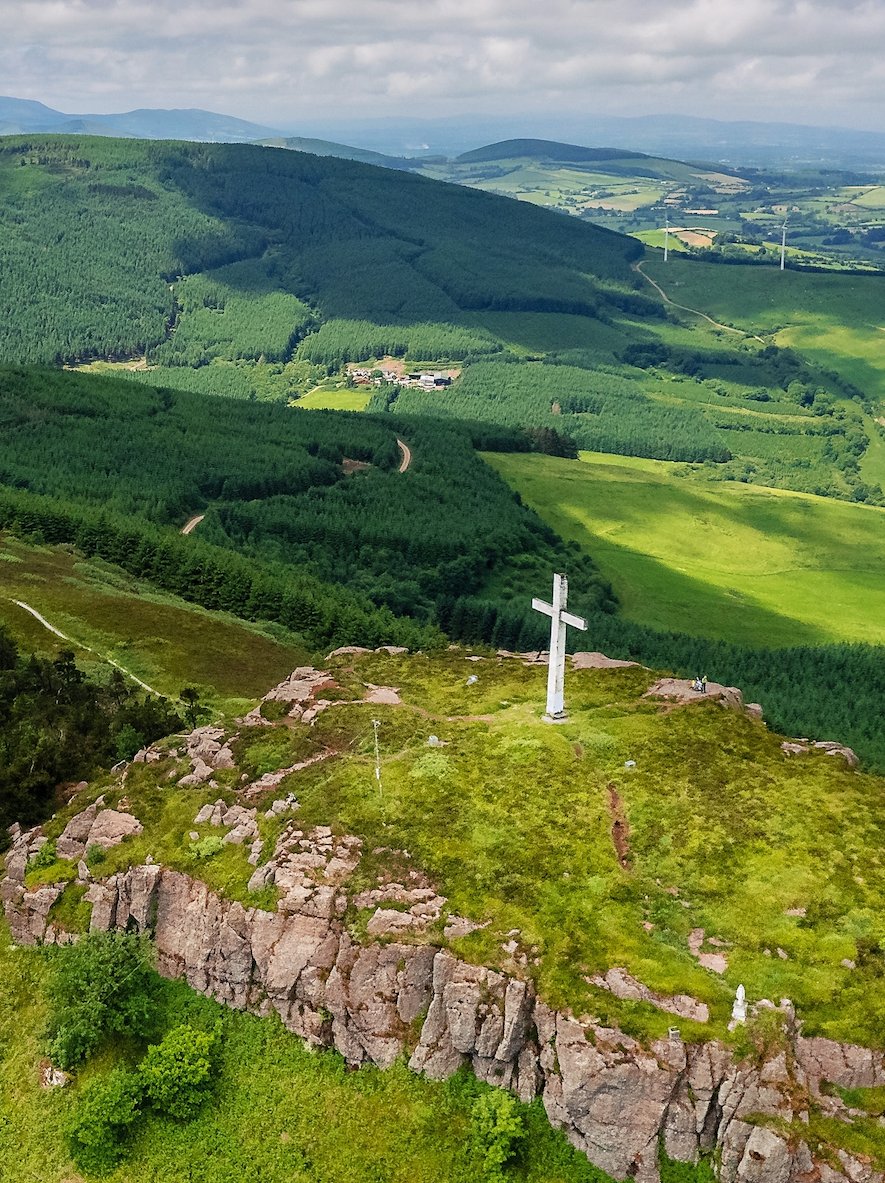
This week in Ireland marks the anniversary of the birth of Seán Treacy, born on February 14, 1895 in County Tipperary — a date that continues to resonate in the story of Ireland’s revolutionary period…
-
This Week in Ireland - Ireland's Newest Public Holiday
Feb 02, 26 12:33 AM
This week in Ireland opens with the country’s newest public holiday in active use, as St Brigid’s Day sets the tone for early February. What was once a quiet cultural marker is now being lived in real…
-
This Week in Ireland - St Brigid's Eve
Jan 26, 26 09:45 AM
This coming week in Ireland culminates with St Brigid’s Eve on January 31, marking the quiet transition between winter and spring. Historically, St Brigid’s Eve is a time for small household rituals r…
-
This Week in Ireland - Approaching St Brigid's Day
Jan 19, 26 04:55 PM
This coming week in Ireland sits at a quiet threshold — the final full stretch before the arrival of St Brigid’s season and the ancient festival of Imbolc. While winter still holds the land, the cultu…
-
Ireland Culture and Customs: Simple Ways to Express Your Irish Side!
Jan 12, 26 09:47 AM
 Learn what makes Ireland culture and customs so fascinating to so many people! Read on to build the culture of Ireland into your day to day Irish expressions!
 -
Cong Village Things to Know
Jan 11, 26 07:10 PM
 Cong Village things to know starts with this: Don't miss it! A lovely Irish town and a wonderful stop on any Irish tour (virtual or otherwise :-).
 -
This Week in Ireland - St Ita's Feast
Jan 11, 26 06:33 PM
St Ita holds a distinctive place in Ireland’s spiritual story — one that feels especially fitting for the quieter stretch of mid-January.
Saint Ita lived in the sixth century, during the formative year…
-
Famous Irish Landmarks: Beyond the Castles
Jan 11, 26 05:17 PM
 There are many famous Irish landmarks that have nothing to do with castles! From quaint villages to majestic landscapes, we share our list of favorites.
 -
Your Irish ID: Share Your Irish Side!
Jan 07, 26 12:04 AM
 Here is where you generate your customized "Irish ID" and use it to proudly share your Irish Side with others!
 -
Irish Christmas Traditions: A Global Celebration with an Irish Twist!
Jan 05, 26 04:01 AM
 Learn wonderful Irish Christmas traditions and customs! This section will help you express your Irish side during the most joyful time of the year.
 -
Adare Castle Things to Know: Fun Facts About An Amazing Irish Landmark
Jan 05, 26 03:59 AM
 Explore Adare Castle things to know: A standing monument to times past, and a wonderful Irish experience to enjoy - with or without traveling to Ireland.
 -
This Week in Ireland - Return to the Pilgrimage Mindset
Jan 04, 26 09:04 PM
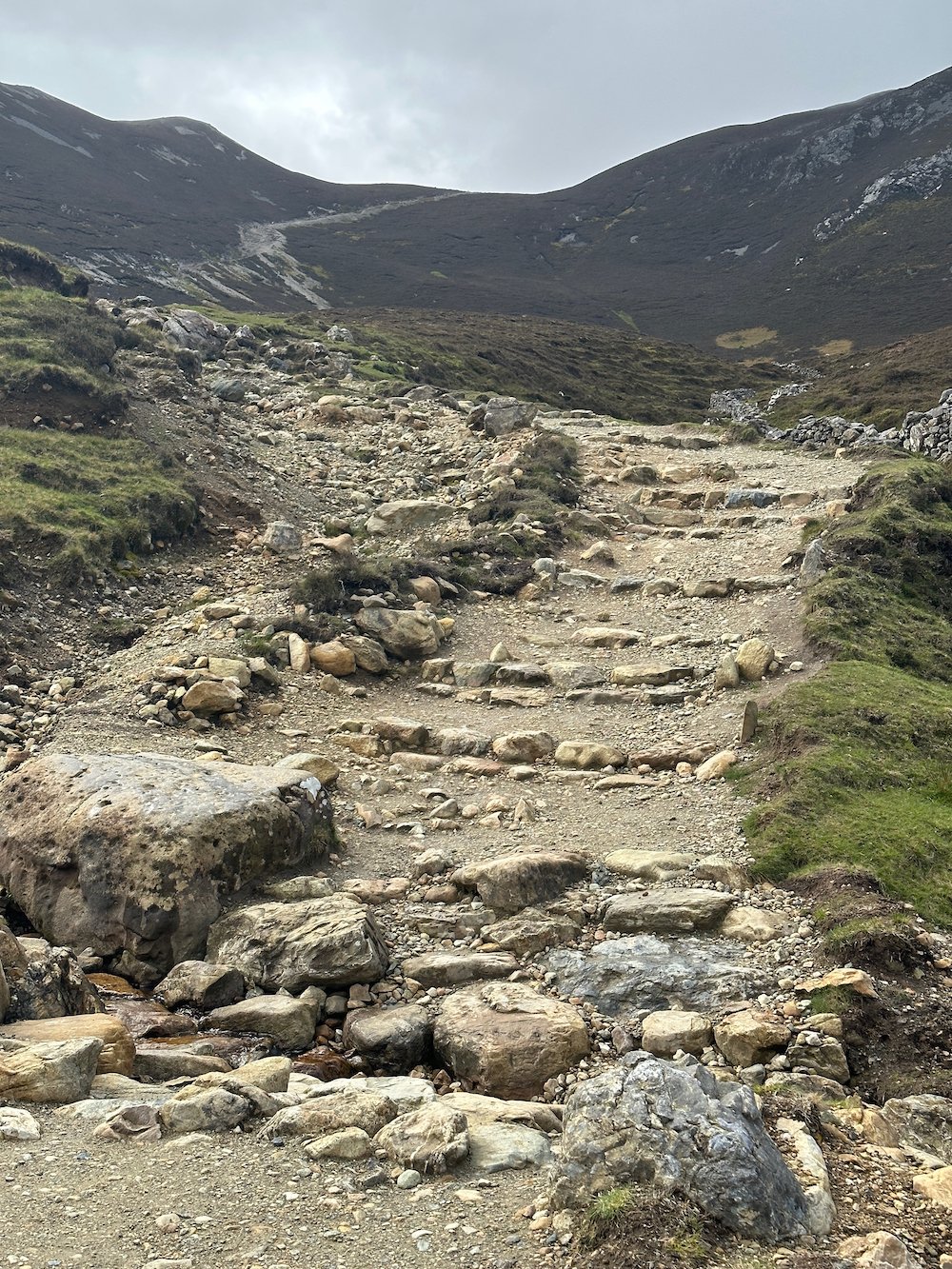 The days immediately after Little Christmas mark a subtle shift in Ireland’s rhythm. Decorations come down, holiday visitors thin out, and the country settles into a quieter, more inward-looking se…
 -
This Week in Ireland - Preparing for Little Christmas
Dec 28, 25 05:24 PM
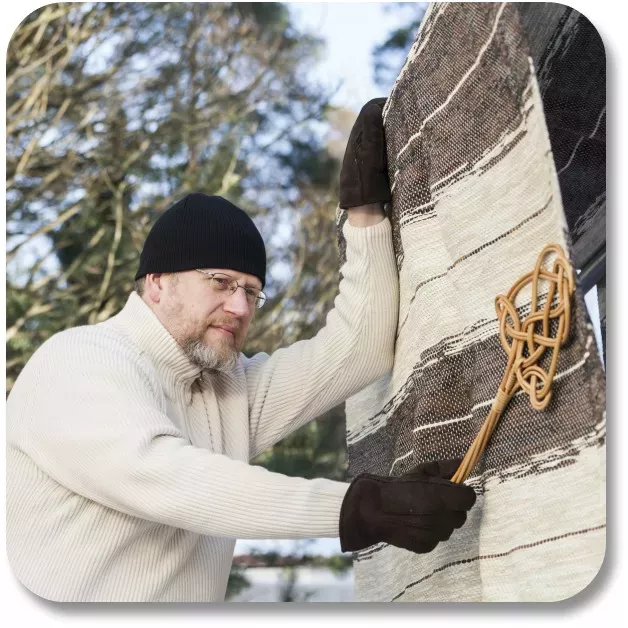 As December draws to a close, Ireland reaches the quiet ending of the traditional 12 Days of Christmas. Year-end rituals such as St Stephens Day take center stage, foretelling the arrival of Little…
 -
This Week in Ireland - The 12 Days of Christmas
Dec 20, 25 01:58 PM
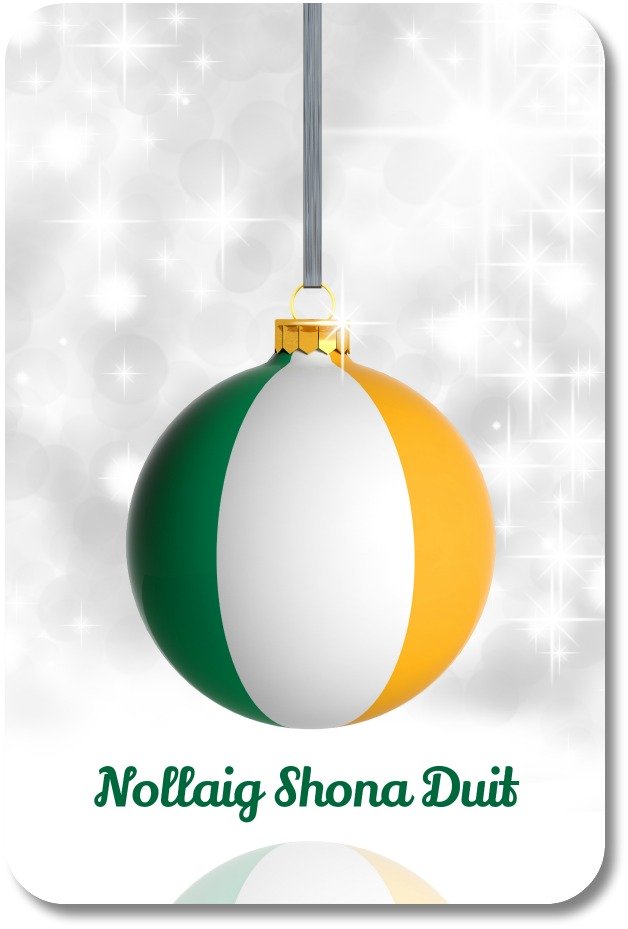 In much of the modern world, Christmas feels like it arrives all at once — and disappears just as quickly. Decorations go up, gifts are exchanged, and by December 26 the season is already winding d…
 -
Newgrange Things to Know: Key Facts About an Incredible Irish Monument
Dec 14, 25 01:37 PM
 Looking for Newgrange things to know? You're in the right place. Older than the pyramids in Egypt, this ancient monument is a historical and scientific marvel.
 -
This Week in Ireland - Winter Solstice and Newgrange
Dec 14, 25 01:13 PM
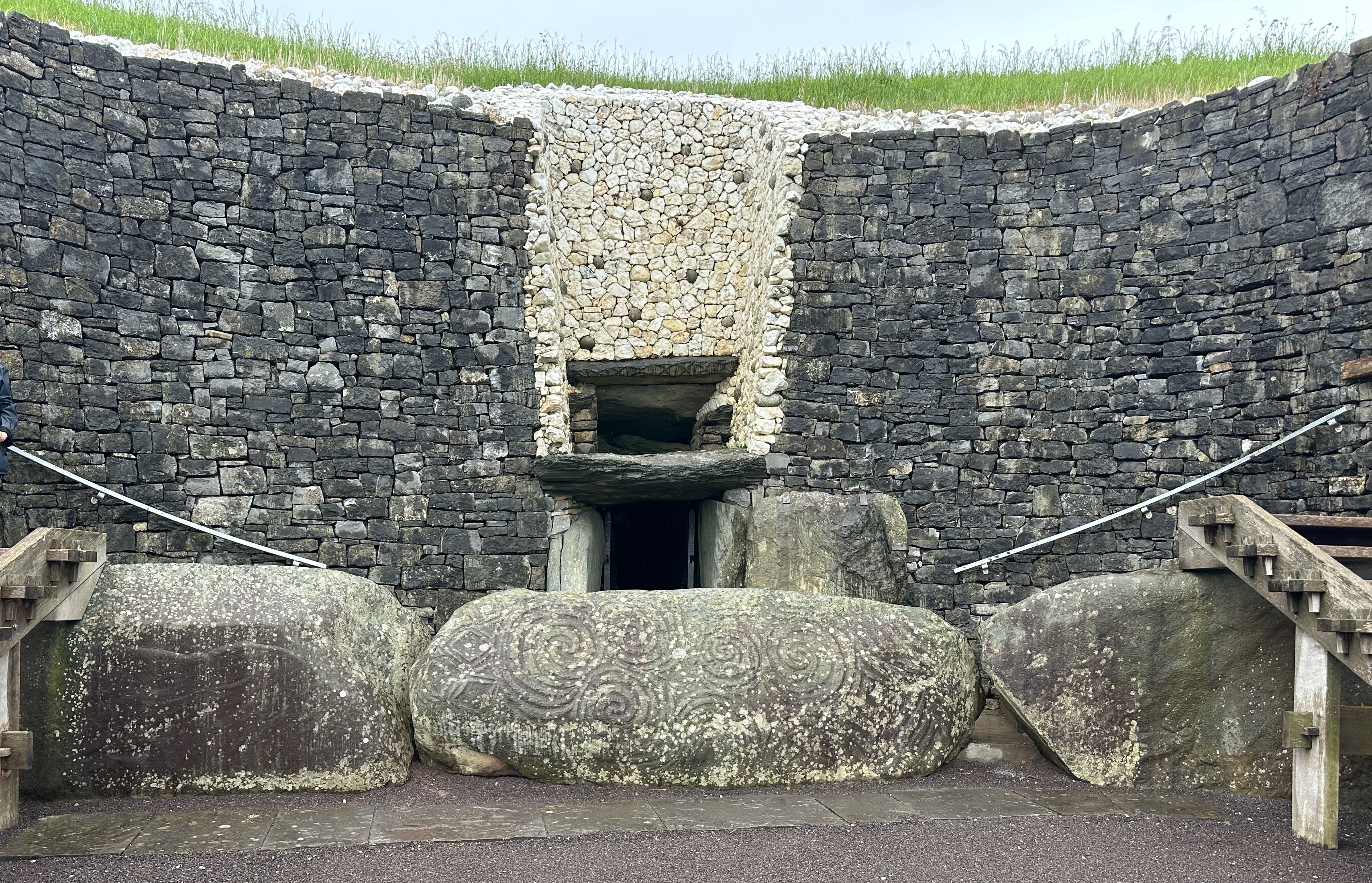 Ireland reaches one of its most quietly powerful moments this coming week: the winter solstice. On December 21, the shortest day of the year marks an annual celestial turning point. Long before mod…
 -
Dunluce Castle Things to Know: An Example of Ireland's Magical Past
Dec 12, 25 09:28 AM
 Dunluce Castle things to know: If it looks familiar to you, it probably is! Featured on album covers and hit movies, it is a very recognizable Irish Castle!
 -
Use Meaningful Irish Symbols to Express Your Irish Side!
Dec 02, 25 07:35 PM
 Irish Symbols are everywhere. Read on to see the Celtic Knot, Celtic Cross, Claddagh, Harp, Shamrock, the Tree of Life, the Triskelion and more!
 -
Irish Song Lyrics: Sing Along to 10 Favorite Irish Songs
Dec 02, 25 07:32 PM
 Here are Irish song lyrics to 10 of the most iconic Irish folk songs. Learn the lyrics, see our favorite performances and sing along to express your Irish side!
 -
Famous Irish Sayings: Proverbs, Blessings, Quotes and More!
Dec 02, 25 07:28 PM
 Here you will find 7 types of famous Irish sayings, including Irish proverbs, Irish blessings, Irish jokes, Irish limericks and Irish slang.
 -
Irish History for Beginners: A Fun Way to Connect to Your Irish Side!
Dec 01, 25 08:59 AM
 Here is a brief and fun overview of Irish history for beginners - where all Irish expressions began! Not your average history lesson!
 -
St Patricks Day Party Ideas: Share Your Irish Side!
Nov 18, 25 03:30 PM
 Finding the perfect St Patricks Day party ideas is the key to celebrating the most famous Irish holiday of all!
 -
St Patricks Day Craft Ideas: Simple Ideas to Adorn St Paddy's Day!
Nov 18, 25 03:26 PM
 St Patricks Day craft ideas give you a personal, colorful way to express your Irish side on St Patricks Day. Here are instructions for a few of our favorites!
 -
Jerpoint Abbey Things to Know: Key Facts About a Historic Irish Site
Nov 18, 25 03:24 PM
 Our Jerpoint Abbey things to know will enrich your visit to this lovely Irish landmark. Read on and enjoy a virtual tour!
 -
25 Irish Words and Phrases to Show Off Your Irish Side!
Nov 18, 25 03:22 PM
 Here are few Irish words and phrases and a bit 'o slang to help you express your Irish side, wherever you are in the world!
 -
Irish Dessert Recipes: Easy Treats With Irish Flavors
Nov 18, 25 03:04 PM
 Learn the most popular Irish dessert recipes, some the tastiest of all Irish expressions!
 -
Irish Birthday Traditions: Celebrating That Birthday Lad or Lass!
Nov 18, 25 02:57 PM
 Knowing a few Irish birthday traditions can take your Irish side to a whole new level. Read on to energize your next Irish birthday celebration!
 -
Irish Baby Gift Ideas: Never Too Young to Share Your Irish Side!
Nov 18, 25 02:54 PM
 Sharing Irish baby gift ideas is a time-tested method of expressing your Irish side! Read on to find exciting gift ideas with an Irish theme.